WHAT’S IN A NAME?
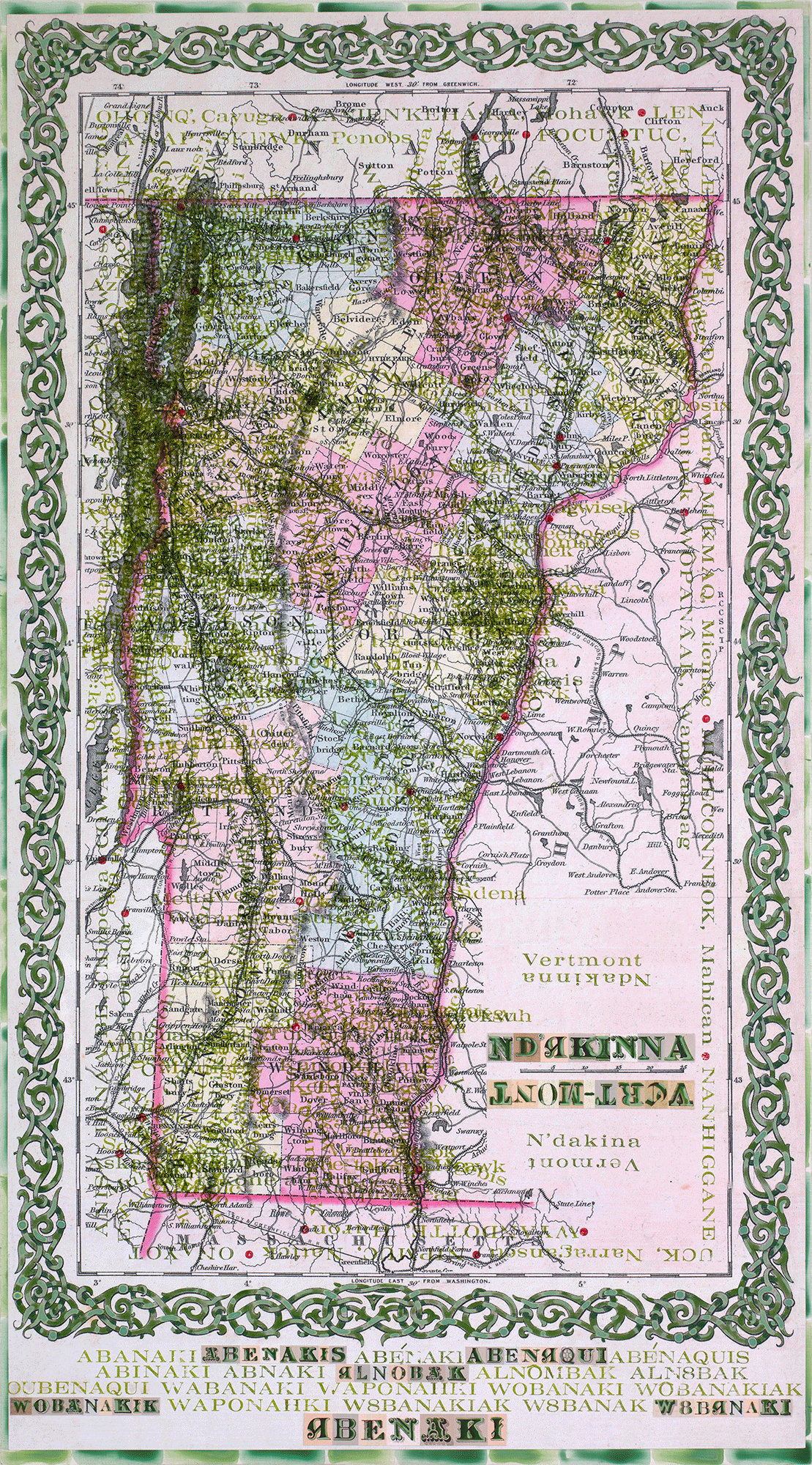
The idea to create HOMELAND Nd’akinna/Vert-mont… came about after receiving an invitation to participate in Parks and Recreation from the Bennington Museum (Vermont). The exhibition explored historical and contemporary interpretations of Vermont’s 55 state parks. Exhibition curator Jamie Franklin was familiar with my work, informed me of Vermont’s 2020 Act H.880 “An act relating to Abenaki place names on State park signs” and invited me to create a work exploring Vermont Indigenous place names. I decided to add them to an historic state map.
Most Abenaki and other Indigenous place names in Vermont, known as Nd’akinna in Abenaki, had been erased and replaced with English settler names long ago, to such an extant that Abenaki place names were not known for each of the state parks. A major source of Abenaki words was provided to me for this project by the Vermont Commission on Native American Affairs, which was compiling names for Act H.880. Additional sources include numerous books, journals, and articles dating from very recently to early 19th century, some of which contain maps and citations dating to the late 16th century. After extensive (but no doubt) incomplete research, I compiled hundreds of Indigenous place names left off most Vermont maps. The names were transliterated into English, often with various phonetic spellings. Place names given by other Indigenous people who lived or traveled through the state were also included, and their names encircle the map.
All names were hand printed in green ink one letter at a time with the exception of the many spellings of “Abenaki,” “Nd’adkinna,” and “Vermont,” some of which are collaged and hand painted. Some places, such as Lake Champlain, had so many names and various spellings that the names densely overlap one another and become unreadable, evoking the topographic features of Nd’akinna.
HOMELAND Nd’akinna/Vert-mont… transcription of hand printed text
HOMELAND Nd’akinna/Vert-mont (with missing indigenous place names spelled variously in green, and existing indigenous place names marked in red), 2021-22, acrylic and ink on cut- and-pasted printed paper on board, 46 ½ x 25 ½ inches
Details


